

The Nutritional Cage
Humans are encouraged to maintain a healthy diet based on four basic principles: adequacy, balance, moderation and diversity. This is described as a balanced diet. At the same time, we’re urged to turn away from ultra-processed foods that are ‘associated with negative health outcomes’[1].
A range of modern diets, including the Mediterranean Diet or the DASH diet, introduce patterns that prioritise food groups over isolated chemical values. Our dogs, by contrast, are expected to eat the same formulation every day. For dogs, we stop at Nutrient Profiles.
Human nutrition seeks to achieve overall health and reduce the risk of disease. Canine nutrition merely seeks to maintain physiological function and prevent deficiency. Thriving versus surviving.
How did we come to this fork in the road?
The separation began in the 1940s, shaped more by circumstance than design. Wartime restrictions on metal use led to tin rationing; pet food was classified as non-essential. Consequently, with tin being diverted to the war effort, pet food manufacturers were prohibited from using metal containers for ‘non-essential’ pet products. The canned food industry, dominant prior to the war, was virtually wiped out. Manufacturers were forced to pivot towards dried, shelf-stable products. The shift was logistical, not nutritional, but its consequences lasted long after the war. Dried food evolved into kibble in the 1950s, which exploded the value of an already very profitable industry.

For humans, the USA produced the Basic Seven. This guide, which even then was built on variety, advised people to eat across defined food groups, with the underlying assumption that, given a broad enough range, the nutritional chemistry would balance itself.
Meanwhile in the UK, wartime rationing demonstrated that diets could be structured around two functional categories: energy foods for fuel and protective foods such as meat, milk, eggs, fish and leafy greens to guard against disease. The principle was simple and practical: variety within constraint. The Dig for Victory campaign, featuring cheerful cartoon characters Doctor Carrot and Potato Pete, encouraged people to grow and eat vegetables.
A side effect of this system designed to prioritise national health was that many lower-income households enjoyed better nutrition than before the war. Just saying…
The canine trajectory
At the same time, dogs were placed on a less pleasant trajectory. The tin shortages in 1942 effectively meant an industrial return to Spratt’s biscuit model, but with a crucial difference: it laid the foundations for the first closed feeding system in which dogs consumed a single processed food every day.
The logic shifted accordingly. Humans were advised to consume a broad range of foods to improve overall health and prevent disease. Dogs, now dependent on a single product, relied entirely on that product to deliver adequate nutrition to avoid deficiencies, based on a reductionist mindset.
Except at that time, there weren’t even nutritional minimums with which to comply. These early foods aimed for shelf stability and basic calories rather than complete and balanced nutrition; there was no definition of nutritional completeness. With deficiencies causing documented deaths – and in the absence of recalls, likely many undocumented instances – the pet food industry had to play catch-up. But rather than looking at weaknesses in the mono-diet those deficiencies had exposed and returning to whole foods, it responded with nutrient standards and fortification.

Even so, it was some time before that happened: distinct nutritional profiles and minimum requirements for vitamins, minerals and amino acids were not formally codified by organisations like the National Research Council until 1962, by which time the US pet food industry was already worth well over $350 million. Nevertheless, the marketing had already started – words like healthy were emerging years before standards even existed.
The rise of kibble

As rationing ended, the two trajectories continued to diverge. Human nutrition in Europe and the UK increasingly rejected heavy fortification models in favour of the quality and provenance of whole foods. The proven benefits of Mediterranean dietary patterns and dietary diversity have created a new gold standard for us: a varied diet of fresh, whole ingredients. Nutritional autonomy – the ability to achieve balance through diversity rather than prescription – is being quietly restored.
At the same time, the pet food industry was well on its way to becoming the global economic force it is today. And it preferred kibble to a varied diet. By 1964, campaigns in the United States were actively discouraging the use of kitchen scraps, reframing them as nutritionally inadequate when compared to scientifically formulated foods.

Maligning scraps and leftovers
Aggressive marketing campaigns discouraged table scraps and leftovers that had previously been fed to dogs, in an effort to establish manufactured food as the normal, safer choice. What had once been normal feeding practice had been recast as unreliable. The implication was clear: variation introduced risk, whereas formulation provided certainty.
The complete and balanced trap
In the mid-20th century, the pet food industry shifted towards a dried food convenience model. For years, however, the mono-diet operated without agreed nutritional minimums. Belatedly, as weaknesses in the model continued to emerge, the industry responded: not by reconsidering the mono-diet, but codifying nutrient standards and introducing fortifications. This cemented a nutrient-first mindset.
The divergence was set in stone in the 1970s. This decade marked a growing recognition that humans needed a new approach to nutrition. Reports in the USA[3] and the UK[4] were advocating for a return to fibre-rich, whole-food dietary patterns. Nutrition science began to shift towards systems thinking, laying the groundwork for frameworks such as the Eatwell Guide and MyPlate, which describe balance across timerather than completeness within a single meal. And the value of the pet food industry, with kibble as a major driver of growth, reached $1.43 billion in 1972.
Enter the synthetic additive
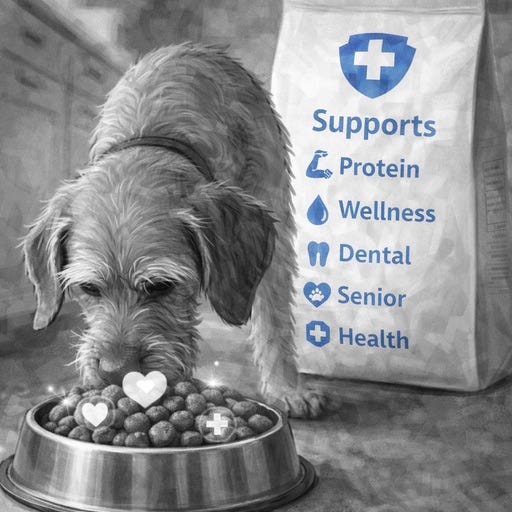
European legislation in 1970[5] effectively mandated the use of synthetic premixes to guarantee compliance with numerical targets. The formation of FEDIAF[6] in the 1970s gathered national pet food associations and major manufacturers under a single European industry umbrella, which led to the harmonisation of requirements across Europe. The result: a system in which canine nutrition became defined by calculation: precise, repeatable and contained within each serving.
Where we are now: the pattern gap
What began as a practical response to wartime constraints has evolved into a rigid, unforgiving framework. And as human nutrition has moved towards diversity, pattern and the recognition of the food matrix, canine nutrition remains confined in a nutritional cage that requires nutritional completeness in every bowl, every day. Even now, each morsel must contain the amount of every required nutrient as prescribed back in 2006, when nutritional science was in a very different era.
And that leaves an open question. If the food matrix and the integrity of whole foods are now considered central to health, how is it logical that our dogs’ food should still be bound by a model based on reductionism and a deficiency mentality, developed in the last century under conditions of constraint? Is this another opportunity to discard potentially unhealthy products and return to whole foods? I don’t know. But I suspect not.
*****
Because, even if we are hoping for movement in the pet food industry over and above treats and toppings, which, incidentally, aren’t covered by the nutritional guidelines for complete meals, this observation from a 2011 study[7] isn’t encouraging:
“However, a key consideration for future committees is whether to continue with the current paradigm of formulating to ensure ‘adequate’ nutrition or to follow approaches in human nutrition that have, over recent years, moved the requirement goalposts from how much of a given nutrient is required to prevent deficiency to establishment of the amount of a nutrient required for ‘optimal’ health or reduction of chronic disease.” (…)
“The previous editions of dog and cat guidelines were 20 years old before they were updated in 2006. To our knowledge, there is no plan to update the current 2006 publication, and new research and knowledge will soon make some of the 2006 recommendations out of date; to remain relevant, a mechanism that facilitates more regular updates is needed.”
Nothing has changed since this was written in 2011.
I, for one, am off to the kitchen…
*****
References
[1] https://www.who.int/news-room/fact-sheets/detail/healthy-diet
[2] Fahey GC Jr, Campion M, Collings GF, Donadelli R, Lambrakis L, Panasevich MR, Peters JC, Templeman JR, Hancock L. The art of establishing mineral tolerances of dogs and cats. J Anim Sci. 2024 Jan 3;102:skae132. doi: 10.1093/jas/skae132. PMID: 38850274; PMCID: PMC11161897.
[3] Dietary Goals for Americans released in 1977 by US Senate Select Committee on Nutrition and Human Needs, led by Senator George McGovern
[4] National Advisory Committee on Nutrition Education (1983) A Discussion Paper on Proposals for Nutritional Guidelines for Health
Education in Britain. London: Health Education Council.
[5] Council Directive 70/524/EEC of 23 November 1970 concerning additives in feeding-stuffs
[6] FEDIAF represents the European Pet Food Industry
[7] Butterwick RF, Erdman JW, Hill RC, Lewis AJ, Whittemore CT. Challenges in developing nutrient guidelines for companion animals. British Journal of Nutrition. 2011;106(S1):S24-S31. doi:10.1017/S000711451100184X

Important Considerations:
- Always consult your veterinarian before making any significant dietary changes, particularly where there are pre-existing health conditions or dietary restrictions.
- If you are feeding commercial food, check the label for ingredients before giving more. Excessive intake of any foods can have adverse effects.
- Ensure (where possible) that you use high-quality, organic products specifically formulated for pets (or better still, human grade ingredients) to avoid any potential adverse effects.
- Introduce new foods gradually to avoid adverse effects such as gastrointestinal upset or diarrhoea.
- I provide nutritional information purely as a helpful guide. Nutritional information on ingredients is obtained from the US Department of Agriculture’s FoodData Central site (https://fdc.nal.usda.gov/index.html) and any nutritional information provided in recipes is based on an online calculator: calories and other information will vary based on brands, ingredients and other factors.
- Check nutrient levels and recommendations for your dog’s weight, age and activity. For example, this nutritional guideline produced by FEDIAF.
- I am not a professional canine nutritionist, but supporting research is cited.
- The recipes shared were created by me and tested in my kitchen – and tasted and approved by our doggy friends!